


Ingredient

lavenders, flowers, flower background, garden, purple flowers, inflorescence, petals, beautiful flowers, purple petals, bloom, blossom, fragrance, flora, plants, nature, flower wallpaper, close up
EU

56 New Fragrance Allergens Added! EU Cosmetic Brands Must Take Immediate Action

The European Union cosmetic industry is currently undergoing its most extensive regulatory update in nearly a decade. Starting July 31, 2026, all cosmetics being placed on the market in the EU must disclose an additional 56 fragrance allergens on their labels, where applicable. This mandate implies critical updates for almost all products containing fragrances or plant essential oils, including: 1. Why is the EU Adding 56 New Fragrance Allergens? In 1999, the Scientific Committee confirmed 26 fragrance allergens required label disclosure to assist consumers in avoiding allergic reactions. Following updated clinical and experimental data from the SCCS in 2011 indicating further sensitizing potentials, the EU released Regulation (EU) 2023/1545 on July 26, 2023. This regulation officially added 56 allergens, bringing the total number of required disclosures to 82 items. 2. What are Fragrance Allergens? Fragrance substances are organic compounds with characteristic odors found in perfumes, skincare, detergents, and other daily

56 New Fragrance Allergens Added! EU Cosmetic Brands Must Take Immediate Action Read More »

Three cosmetic items displayed against a neutral background for elegant product photography.
Brazil

New Anvisa Regulation in Brazil: Over 500 Cosmetic Registrations Canceled; TPO and DMPT Substances Fully Banned!

The Brazilian National Health Surveillance Agency (Anvisa) has officially announced the cancellation of all cosmetic product registrations containing TPO (Diphenyl(2,4,6-trimethylbenzoyl) phosphine oxide) and DMPT (N,N-dimethyl-p-toluidine). More than 500 products are affected, primarily within the professional nail care sector, such as UV gel polishes and phototherapy gels. As a result, the production, sale, and use of these products are now strictly prohibited throughout Brazil. 01 | Regulatory Background: From Prohibition to Total Removal in 90 Days In October 2025, Anvisa issued Resolution RDC 995/2025, which added TPO and DMPT to the list of prohibited substances and established a 90-day transition period. Following the expiration of this period: 02 | Why the Ban? Internationally Verified Health Risks These two components were widely used as photoinitiators or stabilizers in gel nail polishes and LED/UV-cured nail systems. However, international scientific studies have confirmed severe health risks: Anvisa emphasized that these measures are essential to

New Anvisa Regulation in Brazil: Over 500 Cosmetic Registrations Canceled; TPO and DMPT Substances Fully Banned! Read More »

Three cosmetic items displayed against a neutral background for elegant product photography.
Canada

Starting April 2026: Health Canada Requires Disclosure of Fragrance Allergens on Cosmetic Labels

With the continuous global rise in cosmetic regulatory transparency, Health Canada has recently implemented significant updates to the Cosmetic Regulations (SOR/2024-63), requiring the disclosure of fragrance allergen information on cosmetic labels. This update not only impacts the Canadian market but also aligns more closely with European Union (EU) regulations. What does this update mean for brands and consumers? Let’s take a look. Key Requirements and Allergen Disclosure Standards The primary goal of Canada’s fragrance allergen disclosure is to align with European Union (EU) standards, ensuring that consumers—particularly those with fragrance sensitivities—can clearly identify specific allergens rather than seeing them grouped under the generic terms “Parfum” or “Fragrance.” According to the new regulations, specific fragrance allergens must be listed individually on the label only when their concentration exceeds the following thresholds: The Evolution of Transparency: From “Fragrance” to Precise Disclosure For years, the term “Fragrance” provided a safeguard for businesses, allowing

Starting April 2026: Health Canada Requires Disclosure of Fragrance Allergens on Cosmetic Labels Read More »

Three cosmetic items displayed against a neutral background for elegant product photography.
Korea

South Korea Promulgates Amendment to the Enforcement Decree of the Cosmetics Act; Inter-ministerial Briefing Held to Combat Counterfeit Cosmetics.

News Brief 1: South Korea Publishes Amendment to the Enforcement Decree of the Cosmetics Act On March 10, 2026, the South Korean government published an amendment to the Enforcement Decree of the Cosmetics Act. The key revisions are as follows: News Brief 2: Joint Inter-Ministerial Briefing on Counteracting Counterfeit Cosmetics in South Korea On March 12, 2026, the Ministry of Food and Drug Safety (MFDS), the Korean Intellectual Property Office (KIPO), and the Korea Customs Service (KCS) jointly held a briefing in Mapo-gu, Seoul, to address the issue of counterfeit cosmetics. I. Background This briefing is a core component of the “K-Beauty Safety and Quality Competitiveness Enhancement Plan” announced during the 6th National Policy Coordination Meeting chaired by the Prime Minister on November 27, 2025. It aims to tackle the global infringement of popular South Korean cosmetic brands and prevent financial loss to both businesses and consumers caused by the

South Korea Promulgates Amendment to the Enforcement Decree of the Cosmetics Act; Inter-ministerial Briefing Held to Combat Counterfeit Cosmetics. Read More »

Vietnam

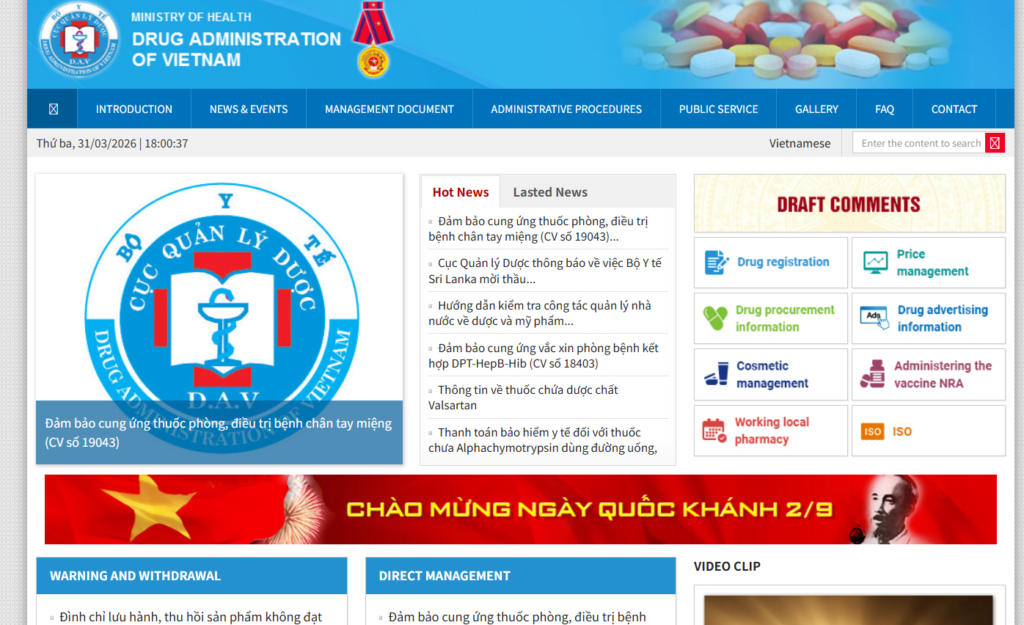
Vietnam Issues Massive Recall of 291 Cosmetics: Full Ban on Products Containing D4

On March 3, 2026, the Ministry of Health of Vietnam issued an announcement on its official website: the circulation of 291 cosmetic products containing Cyclotetrasiloxane and Octamethylcyclotetrasiloxane is suspended, and these products are being recalled. This decision took effect immediately nationwide, drawing significant attention from the industry. This is not only a large-scale product recall but also a clear signal—ASEAN’s regulation of cyclic siloxanes is tightening across the board. I. What Happened? According to the announcement: II. Why the Recall? — Directly Linked to ASEAN Meeting Resolutions The announcement   explicitly stated that this recall is intended to implement In other words, this action was not a unilateral decision by any single Member State, but an enforcement measure under the unified ASEAN regulatory framework. III. What is the Named Substance? The ingredient involved in this action is: These belong to the category of volatile cyclic siloxanes, commonly found in: In recent

Vietnam Issues Massive Recall of 291 Cosmetics: Full Ban on Products Containing D4 Read More »